Tuesday, February 5, 2013

Traveling Thailand, Part III - Old Bangkok

The heartbeat of Thailand is Bangkok, and no visit to Thailand is complete without at least a short stay in one of Asia's most unique and fascinating cities.  One could spend a week in Bangkok and still not see everything.  The "Old City" is a highlight of any visit to Bangkok.

Bangkok was known as the "Venice of the East," from the 17th to the early 19th century.  During this time, most transport in Bangkok was done along the main Chao Phraya River and the smaller network of canals connecting to the main river.  Boats were the main mode of transport until the late 19th century.  Today, using river transport to avoid the infamous Bangkok traffic is still one of the best ways to travel around the "Old City".  Bangkok is known to the Thai's as Krung Thep (City of Angels), which is it's nick name.  The formal name of Thailand translates into one entire paragraph which begins as "Great city of angels, the repository of divine gems, the great land unconquerable..."
View of the Chao Phraya River and the Grand Palace as viewed from Wat Arun

A seat on the water taxi
 The water taxis which run up and down the River are one of the best deals in Bangkok.  A one way ticket, which covers travel from the main stop at Sathorn up the river to the Phra Athit Pier takes about 75 minutes round trip and costs 40 baht ($1.35 USD).  The BTS Skytrain connects with the water taxi stop at the Saphan Taxsin stop - just head downstairs from the Skytrain platform and walk towards the river to the water taxi station!  You can cruise up the river and hop off at the Grand Palace, a great place to start a walking tour of the old city.

One word of warning when walking from the water taxi station towards the Grand Palace... "touts" may approach you to tell you that the Palace is closed, but they are more than willing to take you to temples that are open!  Just smile, ignore them, and keep on walking towards the Palace!  They are trying to get you to hop on to their "friend's" tuk tuk, who will take you to shops of their other friends.  They don't mean any harm, but it is extremely annoying.  The last time this happened to me, the older gentlemen flashed his "Royal Thai Police Badge" - I have seem him every time I go to the Grand Police, but he has stopped bothering me!  The Palace is open every day.  The dress code for the Grand Palace is: covered shoes, (flip flops not recommended) woman must have shoulders and knees covered - skirts, crop pants or long pants are all fine.  Men must wear long pants and covered shoulders.  If you are not appropriately dressed, you can borrow clothes for a small fee from stands right along the complex.  The Grand Palace complex is amazing, probably one of the most crowded tourist attractions in Bangkok, but worth the crowds - just inside the gates is the newly opened Queen Sirikit Museum of Textiles - a beautiful, small museum which showcases the beautiful textiles of Thailand, as well as many of the beautiful Thai silk gowns worn by the Queen.

Inside the Grand Palace Complex
The Grand Palace complex covers over 5 acres of land, and was established in 1782, when Bangkok become the new capital of Thailand, following Ayutthaya and Thonburi.  This amazing complex is also home to  Wat Phra Kaeo, and the most venerated image in the Kingdom, the Emerald Buddha - which is actually made of jadeite!  Immediately inside the gates, you have the option of hiring an English speaking guide - I highly recommend this, you will learn lots of interesting information.


The Emerald Buddha - in his winter attire!


Wat Pho


The Reclining Buddha


Just south of the Grand Palace is Wat Pho, the oldest and largest temple complex in Bangkok.  This temple was built in the 16th century, and is home to one of the longest reclining Buddhas in the country, 151 feet long and 50 feet high.  This temple has resident monks, a highly respected massage school, a school for children and feels like a community center.  The dress code applies to this temple, as well.


Wat Arun


If you are not "templed out", Wat Arun, which is directly across the river from Wat Pho is another wonderful temple complex.  The easiest way to get to Wat Arun is to walk out of Wat Pho and head straight ahead to the Water Taxi Station - Tha Tien.  You can hop onto a cross river taxi for 3 baht - and spend another couple of hours exploring this gorgeous temple complex.  Wat Arun is named for Aruna, the Indian God of Dawn, because legend has it that King Taxsin arrived here at dawn to establish Thonburi as the new capital in 1767.  Wat Arun was built showing a strong Khmer influence in the stule of the prangs.  The story behind the mosaics that cover the prang is fascinating - in the 19th century, Chinese traders who came to Thailand used broken ceramic as ballast in their ships, and rather than throw this ballast out, it was recycled to decorate the temples!  The steep steps mounting the sides of the temple are said to symbolize the challenge that people face as they try to reach a higher level of enlightenment.  The view of Bangkok from the upper level is worth the climb!
Detail of the ceramic mosaics on Wat Arun


The beautiful and classic hotel, The Mandarin Oriental is also located along the river - it is the first stop north of the Sathorn Pier - this hotel is the oldest hotel in the city, opening in 1879, and has hosted such illustrious visitors as Joseph Conrad, Somerset Maugham, Graham Green, Tennessee Williams, James Michener, Diane, Princess of Wales and Prince Charles...This hotel hosts daily high tea, beginning at noon, in the Author's Room, which is in the original part of the hotel.  It is a wonderful way to spend a couple of hours.
The Author's Room, a gracious setting for tea
Tea for Four


The complimentary shuttle from the hotel to the main station

The original Mandarin Oriental 


Wednesday, September 5, 2012

Traveling Thailand, Part II


Krabi was going to be a tough act to follow, but we decided to try another beach vacation - this time to a closer local, Koh Chang.  In Thai, Koh means island, so if there is no "Koh", its not an island.  "Chang" means elephant, so we have Koh Chang or "Elephant Island".  Koh Chang is the second largest island in Thailand, 197 square miles.  It is about a 4 hour drive from Pattaya, to the docks at Laem Ngop, and a 45 minute ferry ride over to the island.  There is a paved ring road which nearly circles the entire island.  The island is ringed in beautiful sand beaches and the interior is covered in rain forest and waterfalls.

The best beaches are along the western side of the
island.  Hat Sai Khao, Hat Khlong Phrao, and Hat Bae are the three main beaches, with a wide range of resorts, from luxurious to very basic.  We spent the weekend on Khlong Phrao, in the Amari Emerald Cove.  It was a much larger, more impersonal resort than our previous stay in Krabi, but it had a fabulous pool, 50 meters long, great for swimming laps!  There were some interesting restaurants on the road just outside of the resort, all within walking distance.  Because this is the heart of the rain forest, it rains frequently, we had one afternoon of torrential downpour!


We spent one afternoon driving down to Bang Bao, which is a fishing village on the very southern end of the island.  The Pier has shops, restaurants, coffee shops and even a couple of small inns, right on the pier.  It has become a bit touristy, but is still a charming spot to spend a couple of hours.  Snorkeling trips can be arranged from the docks here.  
One of the inns on the pier at Bang Bao
Another thatch-hutched inn
Each of the huts is actually a room in the inn
The pier is covered, and the shops are along both sides

Back at the hotel, it was a beautiful end 
to a great weekend in February, 2012
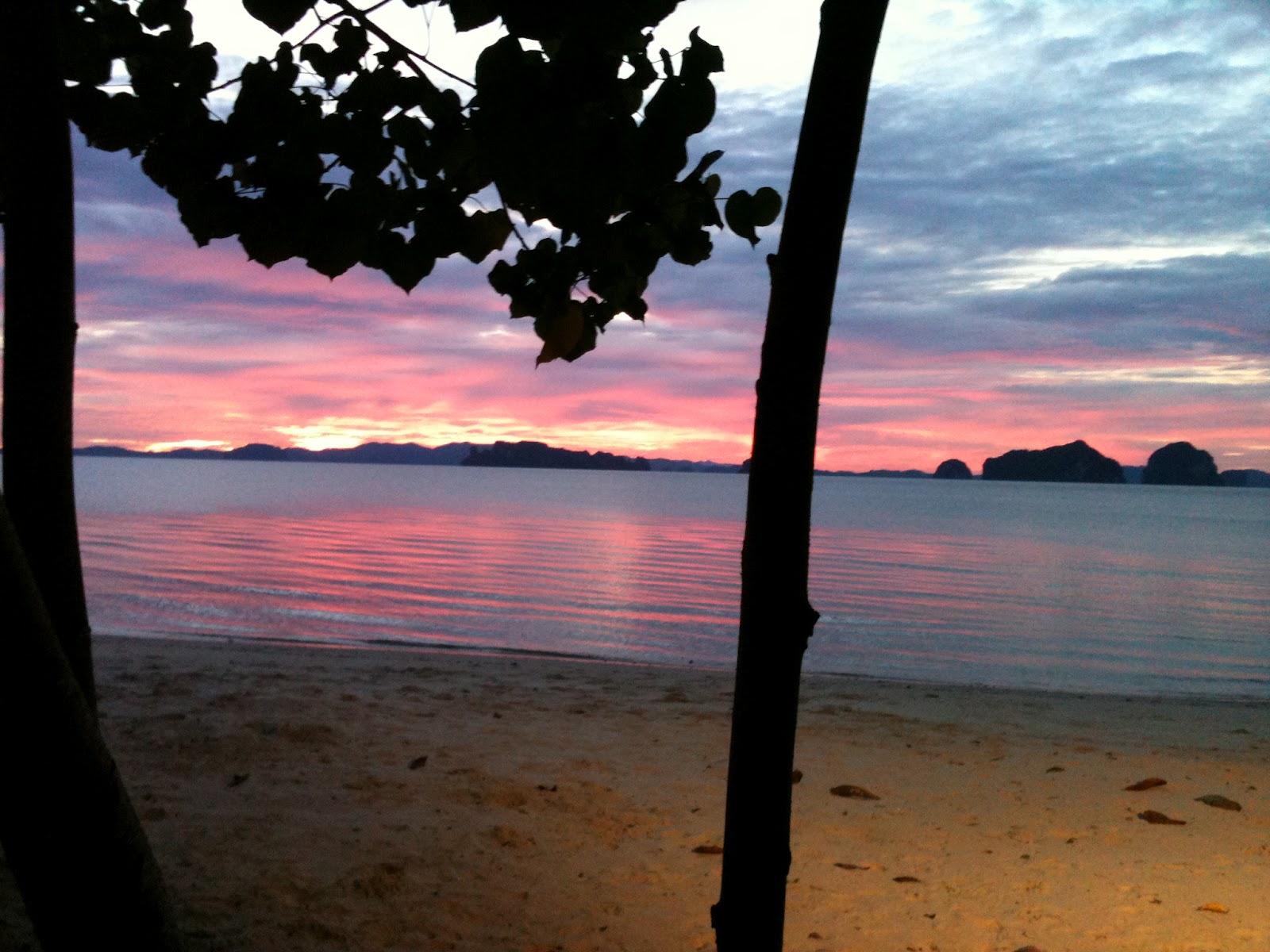
Sunset over the Gulf of Thailand

Friday, August 31, 2012

Travel Time

I have always loved to travel, and this move to Thailand has opened up a whole new world of travel opportunities.  I will use the next few posts to write about some of the travel opportunities, both in and out of Thailand, that I have had during my first year here.

The first trip we took was to Krabi, Thailand.  Krabi is on the southwestern side of Thailand, along the peninsula that connects with Malaysia.  Phuket is the more famous neighbor to Krabi, both are along the coast of the Andaman Sea.  To get to Krabi is about a 10 hour road trip from Bangkok, or a quick one hour flight across the Gulf of Thailand.

We landed at the Krabi airport and drove about 1/2 hour to our resort.  Driving through Krabi reminded me a great deal of Jamaica, very green, lush with the feel of a jungle.  It is quiet, with a small-town feel, no hustle and bustle anywhere.
Sunset on the Tubkaak Beach

These 4 room villas were clustered around the small but cozy resort

We spent a long weekend at the Tubkaak Krabi Boutique Resort.  It is a lovely resort, along the Tubkaak Beach, consisting of 44 rooms, a pool, restaurant and a beautiful stretch of beach.  After the first afternoon, the staff knew our names and our preferences for table seating, etc.  "Boutique" is the new code word for "small and not cheap".  The rooms at the hotel all have outdoor showers and bathtubs, all very private (and a new experience for this northern US girl!)  The longtail boats come right up to the beach and you can rent a boat (and a driver) to take a trip to islands and other sites close to Krabi.  We snorkeled off Koh Phi Phi and Chicken Island, and it was incredible.  The underwater sealife is amazing. I wished that I had an underwater camera.  We brought our own gear with us from the States, because I have never liked the idea of sharing a snorkel!  About 15 minutes after leaving the resort, we got caught in a rain storm and our driver had to pull into a small cove so we could sit out the worst of the storm.  A longtail boat doesn't give much protection when the wind and waves pick up.


Riding on a wooden longtail boat
The outline of Chicken Island


The hotel provided a shuttle to Ao Nang, the little town about 20 minutes from the resort.  There was a bit of night life, shopping and restaurants, but still pretty low key.  We had dinner at an amazing restaurant called "Lae Lay Grill", which is set up on a hill, overlooking the bay.  The food was delicious, the staff attentive, it was a fantastic meal.
The Tubkaak restaurant, as seen from the beach.


I always purchase a "momento" from any trip I take, and my favorite was this 9 inch pewter tray, used by the hotel to serve hand towels to the guests upon arrival.  The tray is made in Thailand by the Loy Far Company, and I fell in love with the little monkey peering up at the edge.  The hotel manager was kind enough to sell one to me from their supply.   

 This was an incredible introduction to the "Amazing Thailand" written about in the travel brochures, and after this weekend experience, we plan on returning to Krabi.  

Thursday, August 2, 2012

Thai Spirit Houses

While spending time in Thailand, one can't but help to notice the beautiful and plentiful "mini temples" seen everywhere.  They are in front of places of business, homes, seemingly everywhere.  These are called spirit houses - and serve an important function in Thai culture.


The origins of the spirit house are older than the Buddhist religion practiced in Thailand.  They originate from the practice of animism, which is the very ancient belief that spirits, or souls, reside not only in humans, but in animals, plants, mountains, rivers and other inanimate objects.  However, no Thai would place a spirit house without first conferring with a monk about placement and the correct "auspicious" day to erect the spirit house.  A sprit house cannot be placed in the shadow of the main house or building, and once properly placed, it assures good blessings for the building or home.  Thai people believe that the spirit of the land must be appeased through offerings made to the spirits who reside in the spirit house.  Spirit houses are usually made of concrete or wood and can be ornately decorated and painted.


The spirit houses are mounted on a pedestal or pillar, high enough to show respect, but low enough for offerings to be easily placed to show respect.  The Thai people believe that the spirits can cause problems if not appeased properly.  One is likely to see a spirit house at the sight of traffic accidents, placed in an attempt to create a safe area in a previously dangerous place!

The spirit houses look like a miniature temple.  In many places one might see two spirit houses, the larger spirit house is for the protective spirit of the land, and the smaller one is a shrine for previous or ancient inhabitants of the land.  A Thai person would likely tell you that the smaller one is for the grandmothers and grandfathers who lived before the previous owners, otherwise known as the spirits of the land.  Offerings made at the spirit houses include drinks, sweets, rice, flowers, incense and small objects for the spirits to use.  Elephants, horses and donkeys are provided so the spirits will have transportation.  Small figures represent servants and dancers, who provide entertainment for the spirits.  Offerings must be made daily to help ensure the families or business' continued prosperity.  If a house or business is sold, demolished or rumored to be a place of bad luck, the spirit house is removed and usually delivered to a Buddhist temple, where it can do no more harm, and a new spirit house will be installed in a ceremony, designed to transfer the spirit from the old house to the new one.

One other interesting belief is that spirits also reside in very old trees.  Brightly colored ribbons tied around the base of the tree indicates that the tree is a "spirit tree", and the ribbons are a way to pay respect and honor the spirit of the tree.


Wednesday, July 4, 2012

Wai Khru Ceremony

I volunteer at the Pattaya Orphanage, which houses 160-170 children, from birth to University age.  The children begin formal schooling outside of the Orphanage at the age of 7.  Until that age, they are taught by teachers in the Orphanage, and I assist with their English instruction.  As a teacher, I was invited to participate in the annual Wai Khru ceremony, which is held in every school in Thailand during the beginning of the new academic year, which is in June.  It is always held on a Thursday, because according to Thai tradition, Thursdays are an auspicious day for teachers.  The Wai Khru ceremony provides the students with the opportunity to thank their teachers for all their efforts in the past and to ask their teachers to continue to provide them with good instruction in the future.

The ceremony started with a Thai chant, led by one of the teachers.  In this chant, the students express their respect for and gratitude to their teachers and ask for the teacher's blessings on their studies.  At the conclusion of the chant, children representing different classes, walked up in pairs, holding floral gifts for their teachers.  They bowed before a small altar.


The students then knelt down and "walked on their knees" in front of their teachers, showing their deep respect for them.  Once all the children had assembled in front of their teachers, they presented their gifts.
The teachers accepted the gifts and wished their students good luck in their future learning.   Although the children were very young, some as young as 3 years old, they watched the older students, and followed their directions and tried so hard to perform their roles perfectly.  They knew this was an important ceremony, and they all behaved so respectfully.  The English teachers were also invited to participate, and the children presented us roses.


The flowers and objects used in the gifts all have meaning in this ceremony.  The Dok Ma Khue, or eggplant flower, is used to convey respect.  When this tree blooms, the branches bend down in the same manner that the student pays respect.  Ya Praek, or burmuda grass, is used to convey patience or perserverance.  Khao Tok is popped rice, which signifies discipline.  Dok Khem is a needle sharp plant which signifies the student's promise to be sharp-witted and brainy.  Candles are included in the display, they represent light and knowledge. The roses represent love.  
This was a beautiful ceremony, I was so honored to be a part of this, and to feel the respect and love from the children and to feel an important part of this Thai tradition. 


Friday, April 27, 2012

Water, water everywhere, but not a drop to drink

One interesting phenomenon about living in the Thailand is the water shortage.  Because the infrastructure can't seem to keep pace with development, there are frequent water shut-offs, with no notification.  In the month of March, our city water was shut off 4 times.

Fortunately, we have a very large storage tank built under our house, which stores approximately 2000 litres of water.  When the city water is flowing, the tank is always full, but our garden watering can deplete nearly half the tank in one evening cycle.  Of the 4 times we have lost our city water, our tank was empty because of the garden watering.

 If you find yourself with an empty tank, there is a second phenomenon in Thailand, and that is the water truck.  The water truck drives around, filling tanks when ordered.  If you call during the day, the truck usually arrives within a couple of hours, and it takes about 30 minutes to completely fill an empty tank, for a mere 400 baht, which is the equivalent to 12 dollars.  Naturally, our tank ran out both times in the evening, the tank truck couldn't get to our house until the next morning, so we spent each evening relying on our drinking water.

In Thailand, unless you have a sophisticated filtration system, you cannot drink the tap water.  We have a free-standing hot and cold water dispenser in our kitchen, which we use for our drinking water and cooking, including washing fruits and vegetables, making pasta and rice.

Our bottled drinking water is delivered by a local vendor who has a shop down the street.  They come once every two weeks and deliver three, 19 litre bottles, for our drinking and cooking needs at a cost of 105 baht for all three bottles (equivalent to about $3).

Along with our personal water issues, comes Songkran, the Water Festival in Thailand!  Songkran is the Thai New Year, which recognizes the "best season" in Thailand, spring, new growth, flowers, and water is an important part of this festival.  Historically, during Songkran, water was used to clean statues of Buddha, and used by Thais to honor their elders by washing their hands in scented water.  The festival has now become one big excuse for a massive water fight.  Weeks before Songkran, stores begin stocking up with water pistols and super soakers, used by both children and adults.  People will sit on the street curbs with plastic bins of water, waiting for cars to drive by.  One can't walk around the downtown streets of any city in Thailand without getting a good soaking during the Songkran festival.  In Pattaya, the festival was celebrated on Thursday, April 19th.  The main streets were bumper to bumper traffic, with people spraying water from their cars and trucks onto anyone who came into their range.  It's a bit like the Woodward Dream Cruise gone crazy wet!


Monday, February 20, 2012

Food, Fruits and the Dining and Shopping Experience


Medium sized prawns, waiting to be grilled!
The food experience in Thailand is a bit different than back in the States.  Most Thai people eat "market food" or "street food", which is made by vendors who have their portable carts right on the sidewalks, or are in larger market stalls, all outdoors.  The grocery stores here in Pattaya have only begun to carry western products in the last few years, and most items from the USA or Europe are heavily taxed and are quite expensive.  For example, a box of Kellogg's or Post Raisin Bran here will cost about $285 baht, equivalent to about $9.50 US dollars.  A tub of sour cream from the US costs $10 US. Cheese is also very expensive, because it is all imported.  So, we try to buy local, or just decide that a box of Cheerios for $10 is something that we must have!  Ice cream is another luxury item.  A very small container of Haagen Dazs ice cream sells for about $10 US!  We have learned to do without ice cream.  Because of the location, seafood is readily available and very reasonably priced.  Prawns are the most popular, and are sold in the whole form, heads and tails included!  Sea Bass is also very popular and is used in fish and chip dishes locally.  It is very inexpensive and is delicious!  When we were looking for a place to live, we saw several condos that did not have ovens, because Thai people don't bake with ovens, several homes had "Thai kitchens" which were covered, outdoor cooking areas.  We live in a "western style" home with an oven and no outside kitchen.


Pineapple, langsat, mangosteen, tangerines, oranges and rambutan (clockwise from the top)

Fresh fruit from the local fruit stand

Fruit is one area where the cost is flipped from back in the States.  Because of the warm weather in Thailand, the growing season is year round, and the local fruits are very inexpensive.  Pineapple farms surround Pattaya, and I can usually  purchase two fresh pineapples for about $1.75 US.  On many occasions, I will see a pick up truck filled with pineapples that are being sold right off the back of the truck on the street.  A bag of 6-8 limes cost $1 US, a bag of passion fruit, which I absolutely love, cost $3 US; back in Michigan, one piece of passion fruit, when I could get the local market to stock it, would cost $3 US.  I have bought a bag of mangos, tangerines and oranges for $100 baht, which is the equivalent of $3 US.  Other incredible fruit here is the mangosteen, rambutan, langsat, lychee, pomelo, bananas, dragon fruit and papaya.  The markets are filled with this beautiful fruit almost all year long and it is a bargain!  I made several loaves of banana bread with bananas from my friend's banana tree, growing in her backyard.  Once the banana trunk bears fruit, it dies off and is chopped down, to be replaced by a young shoot, growing along side the existing tree.  Banana leaves are also used to wrap rice and noodle dishes.
Banana tree in my friend's back yard
Pineapple farm, about 15 km from our house
Most restaurants will have a western menu and a thai menu, western food is usually double the price of Thai food.  One little restaurant that we frequent, located on the beach, has thin crust pizzas starting at $200 baht, and Phad Thai for $120 baht.  Another expensive item to order or buy in Thailand is wine.  The cheapest bottle of wine I have found is about $300 baht, and the average price for a decent bottle of wine is $500 baht, so if you have been keeping up with your conversions, that is nearly $17 for a very average tasting bottle of wine in the grocery story.  No two buck chucks from Trader Joe's here!  Wine is all imported and they add very high import taxes onto it, to boost the price up.  In many grocery stores, they will not sell any alcoholic beverages from 2pm - 5pm, any day of the week.  I haven't gotten a good answer for this one, other than they want to discourage the Thai people from drinking.  Alcohol consumption is not encouraged by the Buddhist religion.  The bars don't seem to have this limitation and will sell any time to any one.  There are even bars on wheels, little vans that set up shop in town during the evening hours, and provide tables and chairs right on the sidewalks and serve drinks and play loud music out of their speakers.  These "portable bars" are intended for the tourist trade, not the local population.

The "Cocktail Car" serving drinks right on the sidewalk in town.
 Starbucks is the one place that is the same at home as it is here, tables crowded with laptops and wireless devices, and lots of good, strong coffee.  You can get a tall, grande or venti anywhere!  Most restaurants in Pattaya serve espresso, it is very difficult to get a regular, brewed cup of coffee.  When you order a cup of coffee you get one cup, no free refills, because each cup requires a new shot of espresso.  McDonalds, Pizza Hut and Kentucky Fried Chicken all have a presence in Pattaya, and as they say in Thailand, "Same, same, but different".  They look they same, but they aren't quite identical.  In McDonalds you can order a "Rice with chicken" dish, right along with a Big Mac!